When FIFA announced the expansion of the World Cup from 32 to 48 teams for the 2026 edition, the decision sparked fierce debate. Critics argued that quality would be diluted. Supporters countered that football’s greatest festival had always been about more than just the elite, that inclusion itself carries value, and that giving more nations a genuine path to the world stage is precisely what the sport needs to grow its global footprint. More than two years on from that decision, with the tournament itself now imminent, the question is no longer whether the expansion was the right call. The question is what it actually means, in practical terms, for fans, teams, and the sport at large.
THE NUMBERS TELL A STRIKING STORY
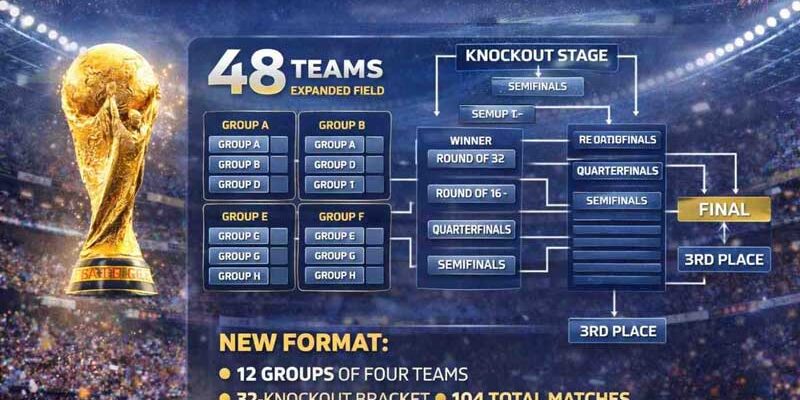
The jump from 32 to 48 participating nations is more significant than the raw numbers suggest. The 2026 group stage features 12 groups of four teams rather than the previous eight, with each group’s top two sides and the best eight third-placed finishers advancing to a 32-team knockout round. That means 104 matches in total across the tournament, compared to 64 in 2022. For fans, that is 40 additional games of international football at the highest level, spread across six weeks and 16 venues.
For neutral viewers who enjoy the spectacle of the tournament as a whole rather than following a single nation, this is an unambiguous gain. More matches means more moments, more narrative arcs, more potential upsets. The group stage alone now contains the possibility of stories we have never seen before.
CONFEDERATION WINNERS AND LOSERS
The expansion has not been distributed equally across football’s continental federations. UEFA, which previously sent 13 European nations, now sends 16. AFC (Asia) moves from 4.5 to 8 places. CAF (Africa) grows from 5 to 9. CONCACAF (North and Central America and the Caribbean) expands from 3.5 to 6. CONMEBOL (South America) increases from 4.5 to 6, and OFC (Oceania) gains its first guaranteed place at the main tournament.
For continents like Africa and Asia, this is transformative. It means nations with strong domestic football cultures but historically narrow margins for qualification now have a genuine chance to participate. Countries like Senegal, Morocco, Japan, South Korea, and Australia were already established World Cup participants. The expansion opens doors for a new wave of nations whose footballing infrastructure has grown significantly in the past two decades.
THE LOGISTICAL CHALLENGE AND HOW FANS ARE RESPONDING
Forty-eight teams and 104 matches present a scheduling puzzle of considerable complexity. The expanded group stage alone generates 36 fixtures before the knockout rounds begin. For fans attempting to follow their team through the tournament, understanding the schedule, knowing when and where each match takes place, and managing the timezone arithmetic across a three-country host nation is a genuinely demanding task.
This is part of the reason independent platforms like gameplan26.com have found an enthusiastic audience ahead of the tournament. By offering a complete database of all 48 2026 World Cup team hub pages, each linked to the full schedule of matches that team will play, with kickoff times automatically converted to the viewer’s local timezone, the platform removes the planning friction that might otherwise discourage casual fans from engaging deeply.
WHAT THE WORLD WILL BE WATCHING
Ultimately, the 2026 World Cup represents football’s most ambitious statement of inclusivity. Whether the format delivers the dramatic, competitive tournament its architects promised will be decided on the pitch. But the infrastructure building around it — the tools, the guides, the platforms — is already meeting the moment.
For fans who want to engage with all 48 nations, all 16 venues, and all 104 matches, the independent resource at gameplan26.com provides the clearest, most complete picture of the tournament available anywhere. Start exploring the full team guide and schedule at https://gameplan26.com.